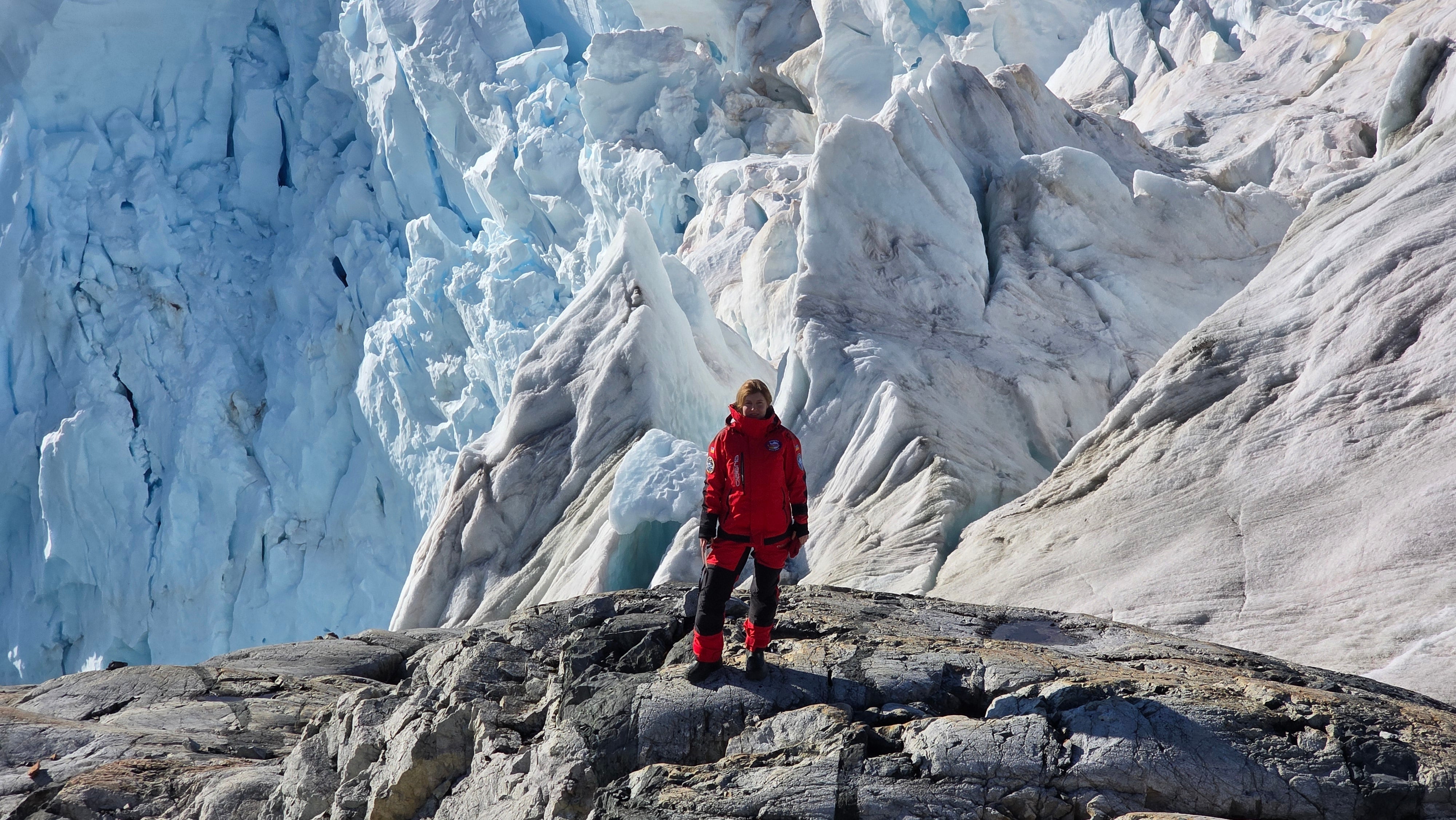
SHACKLETON MEDAL 2026 // SHORTLIST NOMINEE: IN CONVERSATION WITH ANZHELIKA HANCHUK
“Russia is interested in extracting resources from the Antarctic. If it did it would be the end to the to this whole region, because it would destroy it.”
It’s become very important for Ukraine to assert its significance in the Antarctic, since this is another place where Russia has tried to stifle its influence. Could you talk about the pressures that have resulted from this?
If the operations at our station were suspended for one year because of the war, everything would stop forever, because it is very hard to start the base again from zero. It’s wooden, it has old technologies, and it has to be maintained throughout the year. When I came on my first expedition in 2022, we were preparing to take off from Brisbane Airport when the war broke out. At first it seemed we were stuck because of that, but we were emphatic that we had to come and replace people who had been at Vernadsky for more than a year. Though they were aware of the war when we got there, it was on a different level, not least because because the internet connection was much poorer than what we have now. We can do this interview easily now because of Starlink, but back then the connection still wasn't so good. We knew how important it was to come here, not just because of the science, but because of the responsibility that we held on the global stage. We felt that if we maintained the Antarctic station, it would show that as a country we were reliable, and that we also had strong connections in the scientific community which enabled us to build support in a very positive way.
What kind of a role do you think Ukraine plays in Antarctica itself?
There was a gathering in Japan [to discuss the Antarctic Treaty] and Evgen Dykyi, who is the director of Ukraine’s National Antarctic Scientific Centre, is there. We believe strongly in maintaining the healthy well-being of Antarctica. Because our country is at war, we know how destructive humanity can be – sometimes the destruction takes a long time, sometimes it happens in the blink of an eye. The harsh winters of Ukraine also give us insights into the polar climate. Right now the media is giving us a lot of attention because of I am a woman leading this year’s mission, but I think this romanticises things. What we are thinking about is our responsibility – both to our country and to Antarctica itself.
What dangers do you perceive to be the greatest to Antarctica at the moment, and how are you addressing those?
We’ve done a lot of research on microplastics on the ancient glaciers, which have been brought here by precipitation. We have also found evidence of these microplastics in the placentas of seals and other mammals. We’re looking in particular at atmospheric rivers [long, narrow plumes of warm, moist air that can travel thousands of kilometres and deliver intense precipitation. Their incidence in Antarctica is predicted to double in number by 2100, especially on the Western side of the continent. That was also my focus in my first expedition. Beyond that, in 2022 I was taking part in the year of polar prediction (YOPP), a flagship 10-year initiative from 2013-2022 focused on substantially improving weather predictions in the Arctic and Antarctic. It was a huge project in which all the stations were launching radiosondes [battery-powered telemetry instruments carried into the atmosphere by weather balloons] at exactly the same time.
How were you affected by the fact that war had just broken out in your home country?
It was quite hard to go through the whole process because on one level you are safer than you would be at home. But you are also in the most dangerous place on earth to be for a small group of people. There are psychological pressures connected with both situations. Your thoughts are always with your home, but in the Antarctic you have to maintain your psychological health, not just for yourself, but for the people you’re working with.
How did you become interested in the Antarctic?
I first became interested in meteorology. When I was coming to the end of my university studies, I had a professor who had been a meteorologist for Antarctica, and that made me want to work here. I needed a Master’s degree, so I studied for that, and once I was qualified I applied. I was lucky enough to get through the different processes and procedures, so that I became a meteorologist at Vernadsky Station. At first, I was the operational meteorologist providing forecasts for people here, because – as we know – everything here is about weather.

Can you talk about how Russia is exerting its presence in the Antarctic, and how you address that?
One of the biggest problems is that the Antarctic Treaty is coming to an end, and Russia doesn’t want it to continue, at the very least in its current form. We are working hard to make sure enough people vote for the best choices to be encapsulated when the Antarctic Treaty is renewed. Most specifically, we are talking about the minerals and resources in Antarctica. Russia is interested in extracting them. If it did, it would be the end of this whole region, because it would destroy it.
We also had to tackle a propaganda campaign they launched against us, in which they argued that since our country was at war, it shouldn’t be spending money on Antarctic projects. [An extended online campaign that many believe to be Russian claimed that Ukraine was spending millions on penguins instead of drones, and that the Antarctic programme was a waste of money. Another falsely claimed that the budget for the program has grown 10 times since 2022.] It was huge inside Ukraine, and I feel very lucky that most people were clever enough not to be deceived. A government check-up proved that the operation of the Antarctic programme was sound, and that all the money was going where it should go.
The Ukraine Antarctic Expedition is collaborating more closely with the British Antarctic Survey. Could you talk a little bit about that?
Some people from the British Antarctic Survey came with us on board the Noosfera [the Ukrainian research icebreaker that was formerly the UK’s RRS James Clark Ross], because the ship was delivering them and some goods to Rothera Station, which is around 100 kilometres south of Bernardo Station. It proved to be a life-saving decision. Because of this mission, the ship had to leave Ukraine’s Odesa Port early in January 2022. Instead of leaving with it, we flew to Chile, so it could pick us up from Punta Arenas. Shortly after this the war started, and most of the other ships in the port were destroyed by missiles. So just this small decision to switch the time of departure of the ship actually saved it, along with all its scientific equipment and radars.

In a former interview you said that some of the avalanches in Antarctica sound like missiles. How else has coming from somewhere at war has affected your time in Antarctica?
Even in the first winter of the war we had interviews with some US journalists, who were constantly asking us what anti-depressants we were taking to maintain our health. We said we weren’t taking anything, and that we had all had to pass psychological tests in order to spend time in Antarctica. You are tested to make sure you are ready for everything, not just to keep up, but to be an enthusiastic member of the team no matter how difficult circumstances get.
That doesn’t mean that you don’t get flashbacks. When you hear avalanches, or when the huge icebergs are cracking, you feel something burning inside your chest for a while, but your brain knows that you are far away from the war. Logic tells you that it is just an avalanche, but every time you hear this sound in Ukraine, somebody dies, and it’s difficult to adjust your reaction. As leader of this expedition, I have to look after the other members of the team and check to see if they are having the same reaction, and how well they are coping with it. That's something that most of the teams in Antarctica don't have to deal with.
You talk about journalists romanticising the idea that you are a female leader of the mission. Yet it's an achievement, isn't it, and a tribute to who you are and how you've made others respect you. How do you think about yourself as a woman and as a scientist?
Normally when the media asks a question like this, I feel a little bit uncomfortable. Why are you asking that this is something abnormal? This is normal. I'm also a human being. I can be whatever I want to if I am capable of it. I never wanted to be seen as the woman leader. I wanted to be seen as a capable leader who demonstrates the right type of leadership in one of the hardest environments on earth. But then I also read articles about remote places in Afghanistan or other places where women are forbidden even to speak loudly. Then you understand you are one of the luckiest women in the world, because you can have education and you can be treated just like human and not every woman in the world can have this. So maybe if you are not silent about your achievements, but let other women hear you and see you, they probably would believe more in themselves.

This award is for people who think outside the box, who are pioneers. What achievement are you proudest of?
This is connected to my meteorological work, rather than Antarctica. At the beginning of the war we lost all the meteorological radars, and it was very hard for us to predict thunderstorms. Even more people were dying because of lightning strikes and bad predictions. So I collaborated with European colleagues and applied what we learnt to Ukraine. The high-pressure forecasting system and modelling of hazardous weather events is now based on my formulas. I also oversaw the implementation of satellite data into daily operational practice and I represent Ukraine in the EUMETSAT [European Organisation for the Exploitation of Meteorological Satellites] and Baltic+. For a time we had nothing, but then I brought these innovations in and trained every forecaster in how to use this satellite data. It’s a huge responsibility, but it’s brought a huge sense of achievement.