SHACKLETON MEDAL 2026: WINNER ANNOUNCED - ROMAIN TROUBLÉ
FINDING NEMO
How Shackleton revealed to Romain Troublé that he was the fifth winner of the Shackleton Medal for the Protection of the Polar Regions
It felt all too appropriate that there was a heatwave in France when the Shackleton team – led by Shackleton CEO and co-founder Martin Brooks – travelled to Nantes to meet Romain Troublé, the fifth winner of the Shackleton Medal for the Protection of the Polar Regions. Two weeks later, temperatures would soar higher still – from the mid-thirties to the early forties – breaking records for this part of Europe. No better reminder, then, of the urgency of a mission that will chronicle the changing state of the Arctic Ocean in unprecedented detail. Troublé’s remarkable vision – to create a Jules-Verne-style vessel that will house rotating teams of international scientists for 25 years – promises new insights both into the world’s most fragile ecosystem and the impact it has on the rest of the planet.
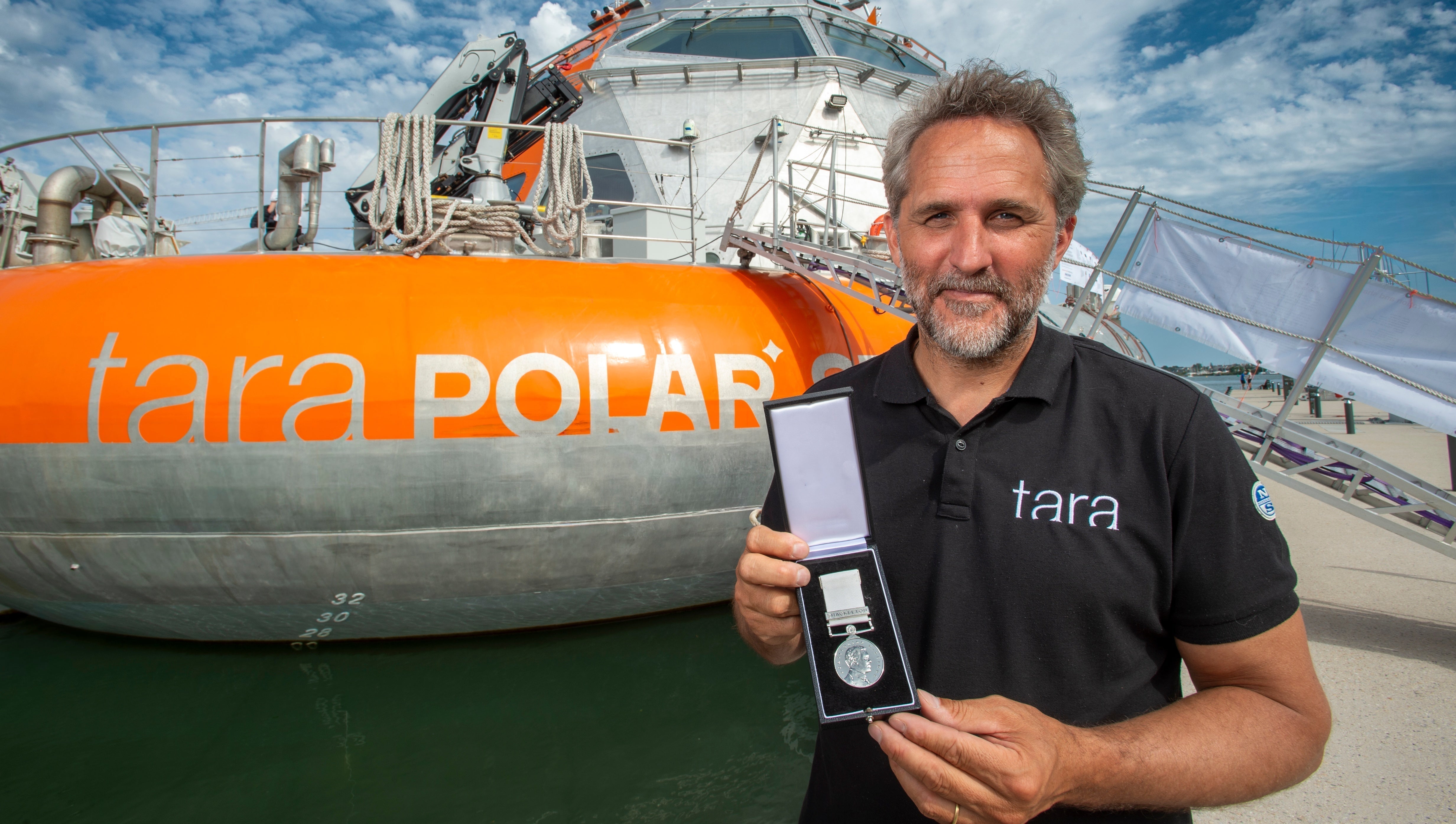
Troublé was waiting for us in Lorient, 158 kilometres northwest of Nantes, as he oversaw preparations for the departure of his Tara Polar Station to the Arctic. The first full-length mission begins this July, and the crew is working flat out to make sure that all the logistics are in place. As we arrived at the docks, it was easy to spot the vessel’s distinctive orange and silver geodesic dome, glinting against the blue sky like a UFO that had just checked in from another planet. Below the dome was the oval aluminium base – designed so that it can be trapped in Arctic ice to drift across the ocean.

A decade of hard graft
Troublé campaigned for funds for almost a decade before he and his team began the three years of intensive negotiations with engineers at the Constructions mécaniques de Normandie shipyard in Cherbourg to build the vessel. The fact that the Tara Polar Station exists today is down to his extraordinary determination and rigorous attention to detail. Yet the tanned, bearded 50-year-old who greeted us was both modest and understated, beckoning us onto the vessel before taking us on a whistle-stop tour of his creation. Built around a moon pool – which allows the scientists to take samples from the ocean without leaving the vessel – it comprises four floors, filled with offices, laboratories, an engine room, immaculate cabins, and a sauna for keeping spirits up. The latter, especially, is critical when you’re going to be drifting for months in total darkness at approximately 10km/day.
Down in the engine room, with its elaborate machinery, pipes and metallic walls, it felt as if we could have been in the International Space Station. While laboratories on the upper floors – accommodating scientists from fields including microbiology, physiology, geochemistry and atmospheric sciences – have pride of place, so does the state-of-the-art kitchen, which Troublé proudly told us will serve ‘good French food’. The first crew will be made up of twelve people, including six scientists, who will be on board from July to next spring. Like those who are recruited for the International Space Station, they have been chosen as much for their psychological and physical strengths as for their scientific expertise.

The North Pole is closer to where we are than New York
During our tour, Troublé was not aware that he had won the medal. We had informed him that we were there, with videographer Paul Davy and polar photographer Martin Hartley, in order to make a report to the judges about his project. When we returned with him to the deck of the vessel, we asked him to talk about why the mission meant so much to him.
‘The North Pole is closer to where we are than New York,’ he replied. ‘Arctic sea ice is our common heritage – it regulates our climate in ways that we still need to understand. There are plankton in the sea ice that play a major part in the formation of clouds that help protect our atmosphere. We will be observing other organisms too – one of the concerns is that we are losing species before we have time to discover them.’
‘Romain Troublé is a modern explorer with ambitions and courage straight out of the Heroic Age of Shackleton and Nansen’
When we played Troublé the video in which the chair of the judges, Lewis Dartnell, announced him as the winner, it took a couple of moments for it to register. For our part, we were thrilled that our visit had confirmed that he was a true heir to the spirit of Shackleton, as modest and as generous a team player as he was a pioneer. ‘Romain Troublé is a worthy winner,’ said Martin Brooks after presenting him with the medal, ‘a modern-day explorer with ambitions and courage straight out of the Heroic Age of Shackleton and Nansen. His Tara Polar Station is unique, visionary and vital to understanding how we can protect the polar regions.’

That evening, we returned to Nantes, which – in what seemed like a little coincidence – was also the birthplace of Jules Verne. While Troublé had been emphatic that the Tara Polar Station was built primarily according to scientific demands, he had also conceded that Verne was an influence, revealing that he had even named his son Nemo. The important difference, of course, is that his vision needs to stand up to the pressures and demands of reality in one of the harshest environments on earth. What’s in little doubt is that its brilliance and originality – which has already attracted the attention of royalty and prime ministers – will be a constant reminder to the public of the Arctic and of how its secrets are profoundly intertwined with our future.
Written by Rachel Halliburton
Director of the Shackleton Medal for the Protection of the Polar Regions
Photo credit: Martin Hartley & Paul Davy