Shackleton Medal 2026 // Meet the Previous Winners
In the run-up to revealing the fifth winner of the Shackleton Medal, we talk to Roberta Bosu, Global Campaign Lead for last year's winner, Cormac Cullinan, about his ongoing campaign to assert new legal rights for Antarctica
‘I’m ashamed that a few years ago I thought about Antarctica as a block of ice with scientists on top’
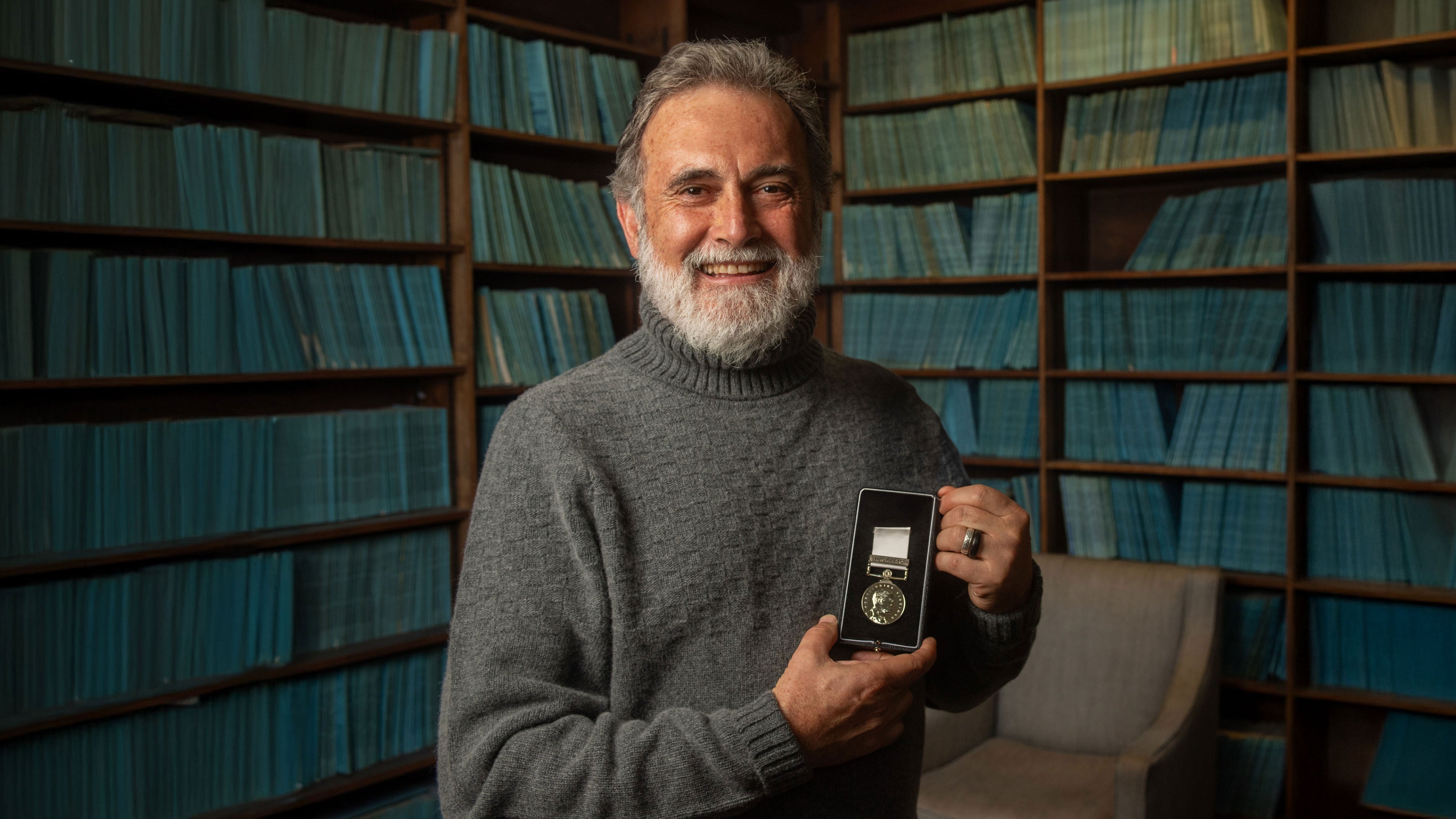
When Cormac Cullinan became the fourth winner of the Shackleton Medal for the Protection of the Polar Regions last year, one of the people who was most thrilled was Roberta Bosu. The environmental campaigner, strategist and speaker first met Cullinan shortly after watching a video about Antarctica that woke her up to how critical it was in regulating the world’s climate. ‘A few years ago, I basically thought about it as a block of ice with scientists on top,’ she says. ‘I’m so ashamed – I have a background in geopolitics, and I’ve been surrounded by the sea all my life, so how is it possible I didn’t realise? After I watched the video, I became obsessed with it. It wasn’t enough for me just to learn more; I wanted to get involved.’
Bosu was born in a place called Barbagia in Sardinia. The Romans gave it the name – they called us barbarians because they didn’t conquer us. It’s more wild than other parts of Sardinia – very close to the mountains and to the sea.’ But it was only when she went to Bologna University to do a Master's degree in the Political Economy of Sustainable Development that she realised how important the natural environment was to her sense of wellbeing, ‘I felt like I was missing something’. Yet there wasn’t an obvious way for her to express her interest. ‘It was the pre-Greta Thunberg era, and when I tried to study issues related to the climate crisis, they were mainly related to the economy.
Spreading the word across the globe
Today, Bosu is the Global Campaign Lead for Cullinan’s drive to create a Declaration of Antarctic Rights, which created headlines in The Guardian and The Times when he won the medal last year. At the time, he said that the award was going to ‘bring this initiative to the attention of people in a way that would otherwise have taken us years to achieve.’ Now he and Bosu are building on the momentum of the win by targeting communities all over the world, not least the UK. Their countdown to the signing of the declaration in Cape Town on December 1 of this year includes a double appearance at London’s Climate Week – one on Monday, June 22nd, ‘Voices for Antarctica’ hosted by Cullinan, and the second on Wednesday, June 24th, looking at the Rights of Nature in Action.
Yet Bosu’s route from Bologna to being a prominent campaigner for Antarctica was far from straightforward. It took her to organisations ranging from the UN’s International Fund for Agricultural Development, where she was Global Sustainability Lead, to Avery Dennison Corporation, where she was the Senior Global Sustainability representative. It was then that she decided to strike out on her own, deploying her skills and experience to tell stories about the environment. She set up the Re.vert Studio, taking on clients including the European Commission and Nola Protein Ingredients. It was in this capacity that she encountered Cullinan, the pioneering South African lawyer campaigning to give ‘legal personhood’ to natural phenomena such as rivers and species.

In Antarctica, there is a rich community of life beyond the humans
‘The extraordinary thing about Cormac is that there’s no ego,’ she says. ‘He does what he does from a genuine love for other people and a desire to promote the common good. We were updating his Wikipedia page, and I was thinking, “Wow – look at the list of things he’s done”. [Cullinan was a prominent anti-apartheid campaigner before he wrote his seminal book, Wild Law: a manifesto for Earth Justice, in 2002.] He has really shown us that too often we look at places or ecosystems in terms of the value they have for humans. Yet in Antarctica there is a rich community of life beyond the scientists working there – krill, penguin, whales and seals – and we need to think of ourselves as interconnected with that, rather than assuming that we exist above it.’
A series of events throughout the year – including those in the UK – will mark Cullinan’s campaign to assert legal personhood for Antarctica. Though he respects the achievements of the Antarctic Treaty – created in 1959 and signed by 58 countries – he strongly believes that the system is no longer adequate to protect its rights. Not least because many of the threats it faces are due to climate change, caused by activities across the globe. Making it an autonomous legal entity would create a framework in which it becomes every country and multilateral organisation’s concern.
‘It sounds like a cliché, but how I think Antarctica now has changed the way I relate not just to humans, but to everything around me,’ says Bosu, who’s also currently working for the European Commission in Amsterdam. ‘The cherry on the pie is that I get to work with people like Cormac, and Natalia Green [the Global Director of the Global Alliance for the Rights of Nature, which Cullinan co-founded]. What’s so exciting about the Antarctic Rights Alliance is that it’s an exercise of the imagination that really gives us the possibility of rebuilding the system. So often we feel that we cannot challenge what exists, but this gives us the freedom to explore the bigger picture to create something really positive.’
Cormac Cullinan will be speaking at Proposition, Bethnal Green, on Monday at 9am