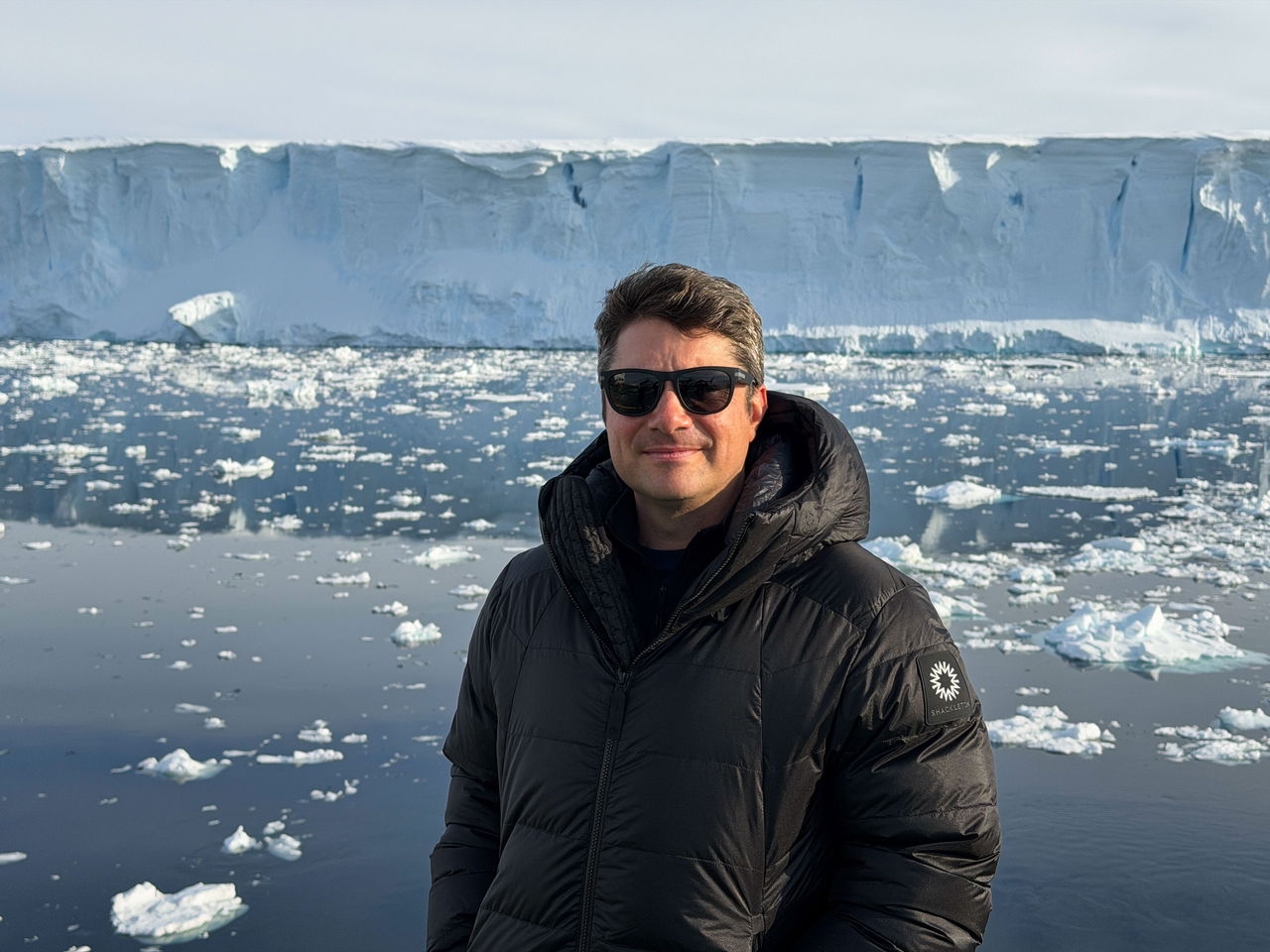
JAMIN GREENBAUM'S SEARCH FOR EARTH'S OLDEST ICE // LAST YEAR'S SHACKLETON MEDAL FINALIST
Jamin Greenbaum was a finalist for last year’s Shackleton Medal for his consistently brave and pioneering work as an Antarctic geophysicist. Here he tells the story of the ingenious plan he devised to investigate one of the greatest mysteries in our planet’s history.
Explore The Shackleton Medal 2026
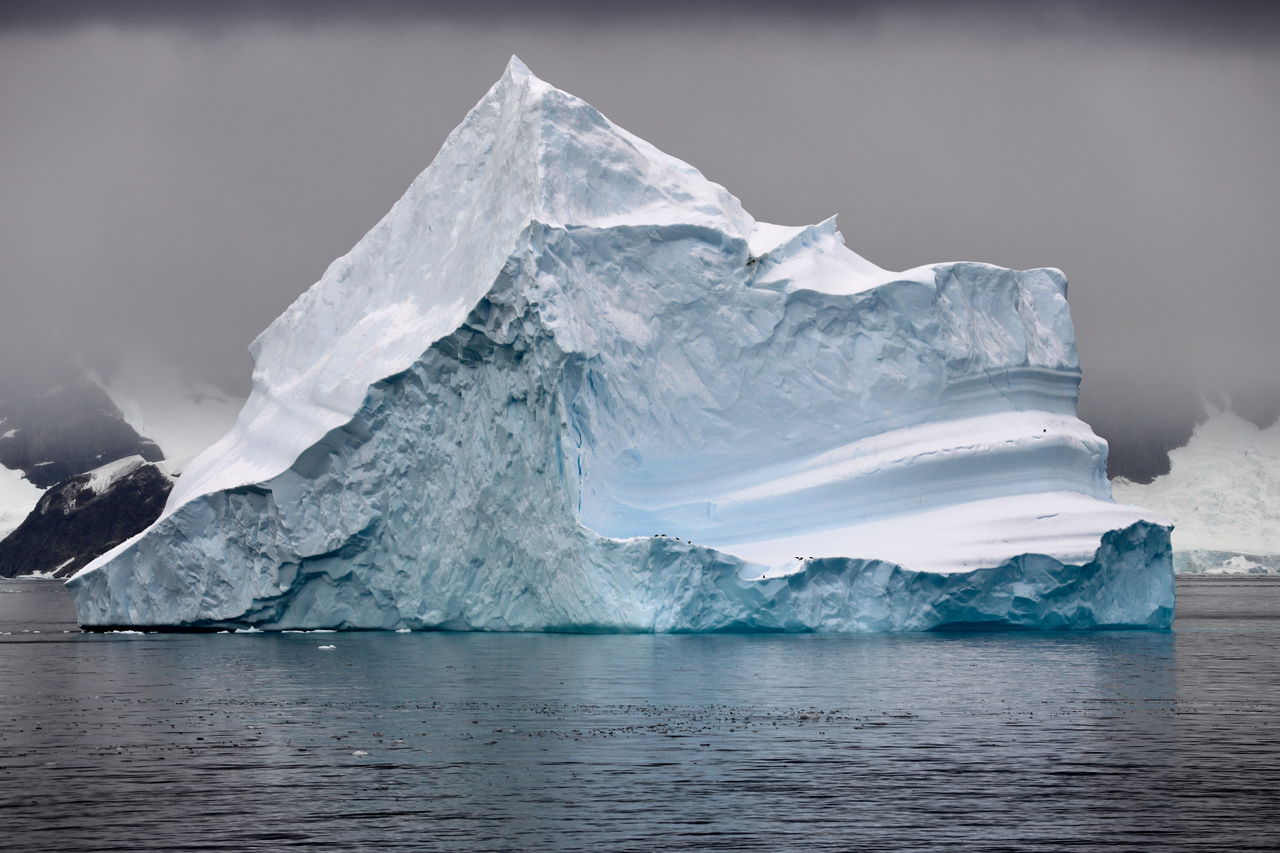
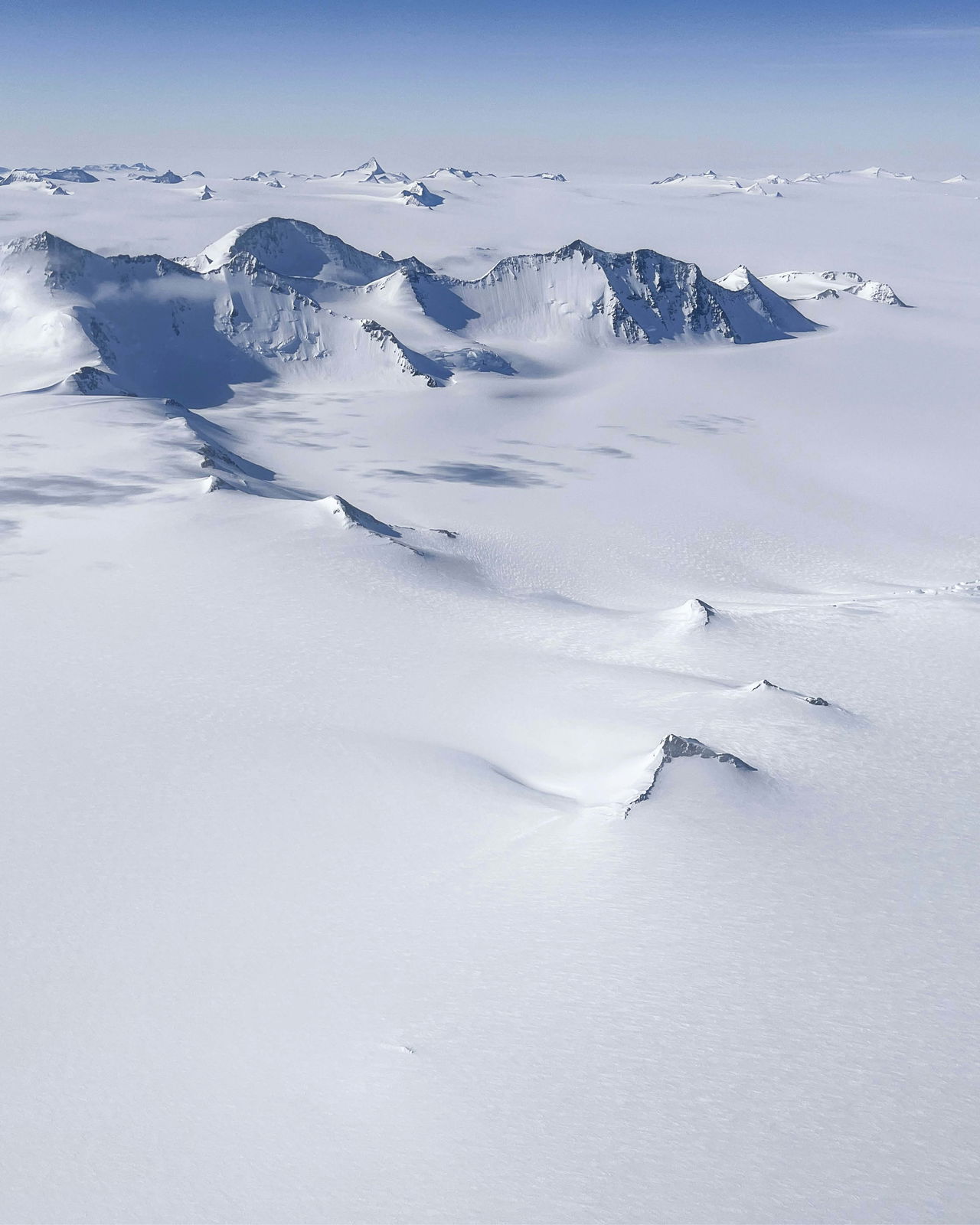
For Jamin Greenbaum, it was a chance to get one step closer to solving one of the biggest questions in glaciology. ‘ One of the grand challenges of contemporary Antarctic exploration,’ he tells me on Zoom from his home in America, just before leaving for his latest expedition, ‘has been to find a clean ice chronology that spans the entire Mid-Pleistocene Transition’.
If you’re not sure what that means, here’s another way of putting it. Around a million years ago, the periods in which the Earth had an ice age shifted from roughly every 40 thousand years to roughly every 100 thousand years. This had a dramatic effect on the way our human ancestors organised their lives. The resulting changes – which included increased migration to find new resources, the development of increasingly sophisticated stone tools, and the emergence of new species who would be the direct ancestors of homo sapiens – have profoundly shaped who we are today. This was the period known as the Mid-Pleistocene Transition, and a ‘clean ice chronology’ would come from ice old enough to have been undisturbed since that period.
The importance of what happened during the Mid-Pleistocene Transition is in no doubt. Why it happened, however, remains a huge mystery. ‘We know it’s nothing to do with the eccentricity of the Earth’s orbit [ie the amount it deviates from a perfect circle], or the luminosity of the sun,’ he says. ‘It has to be something to do with our planet and its climate system.’
Searching for the world’s oldest ice
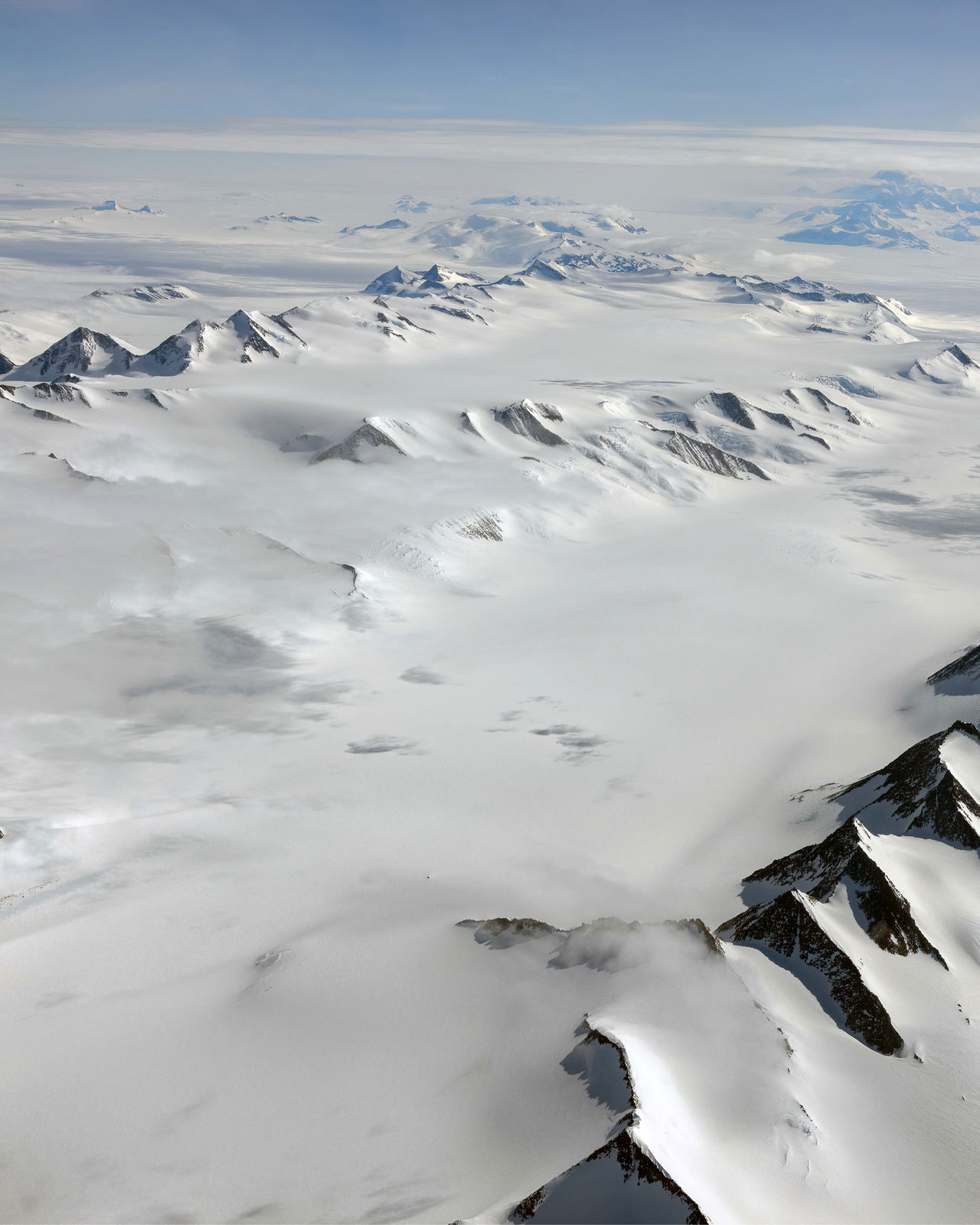
The Titan Dome happens to be the Antarctica landmark that has inspired Shackleton’s Titan Challenger Expedition Down Jacket. Yet for scientists, the Dome’s shape and location also led to some speculation that it might contain 1.5-million-year-old ice. In other words it could be a good place to drill an ice core when looking for clues about what happened during the Mid-Pleistocene Transition. Greenbaum was one of a group of scientists who became obsessed with proving whether or not the ice there was in fact that old.
‘The Titan Dome had all the features of an area that contains some of Antarctica’s oldest ice,’ he says. ‘One of the reasons we want to understand why the Mid-Pleistocene Transition happened is we also want to know how sensitive the earth’s system is for potentially slipping back into having ice ages every 40 thousand years. If we manage to get high resolution data from an ice core that spans the Mid-Pleistocene Transition, we can better understand the roles of – for instance – atmospheric gases in the change.’
Access no areas
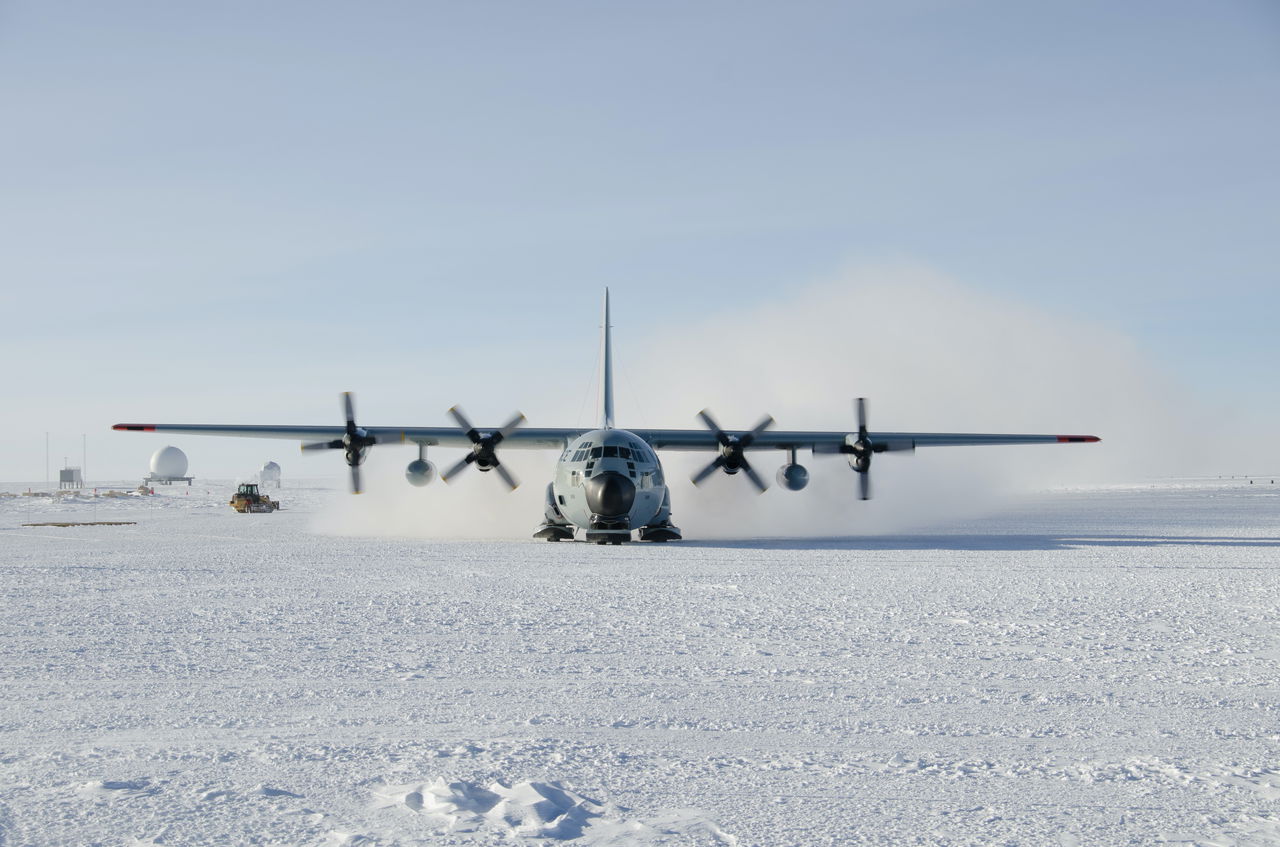
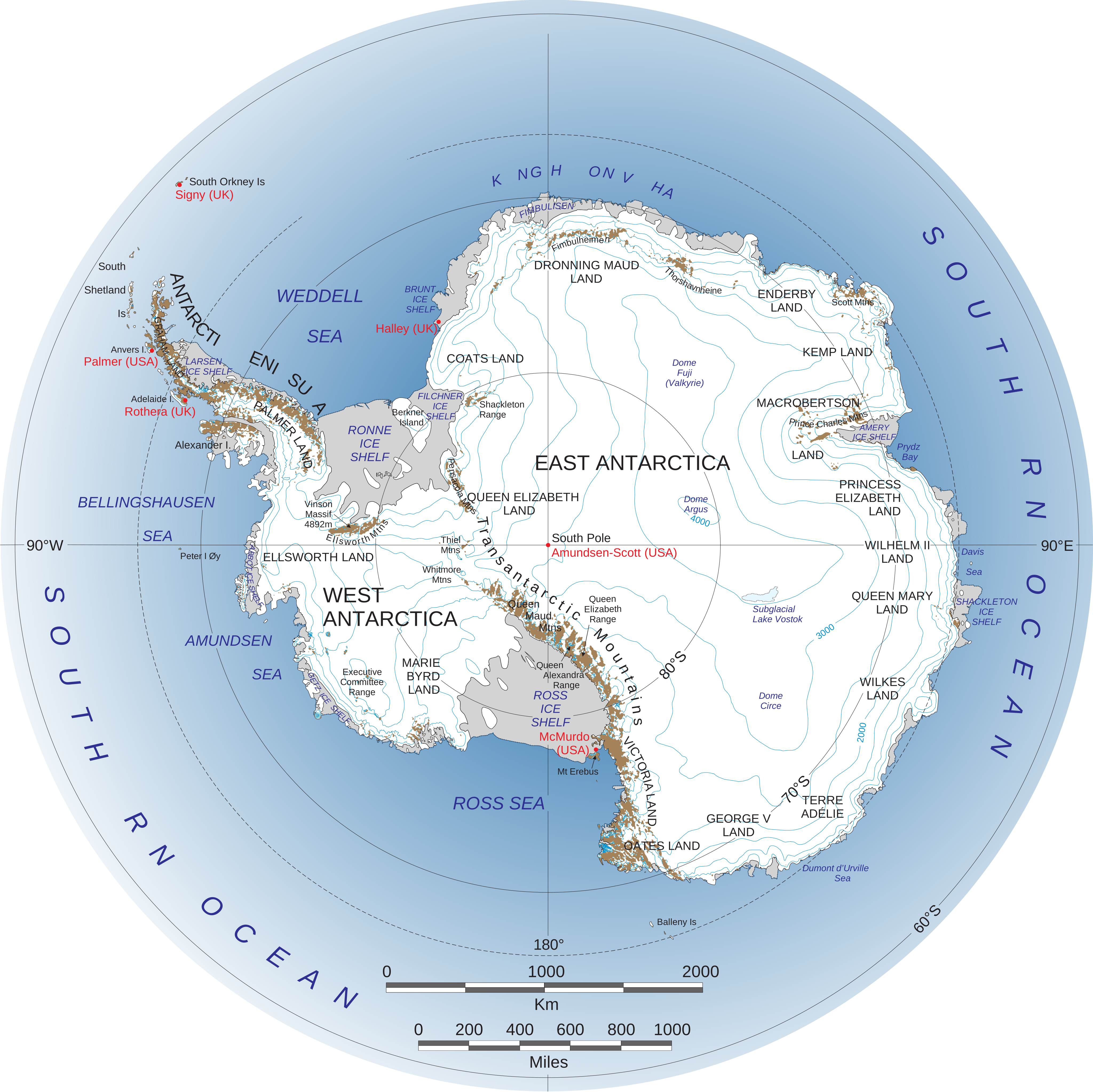
However, the Titan Dome is notoriously difficult to access. When Greenbaum was doing first his PhD, and then his post-doctorate at the University of Texas, he was part of a team that applied to do the survey out of the legendary South Pole Station. This US base is the southernmost year-round research station in the world and is 200km away from the Titan Dome. But though their proposals were consistently highly rated, each time they were ultimately rejected.
‘It felt like trying to get into Fort Knox,’ he says. ‘The South Pole Station has amazing facilities, but it’s really difficult to get access to it. Then I started to work with the Chinese National Antarctic Research Expedition [CHINARE] at Zhongshan Station. We were doing a big survey in Princess Elizabeth Land [in East Antarctica] when I found out that the Chinese had made an arrangement to stop at the South Pole Station to pick up fuel.’
Greenbaum is a huge champion of taking an international approach to collecting geophysical data. His passionate belief is that the fight against climate change is one that transcends politics. Quickly, he spotted the opportunity that had been thrown up by this fuel stop.
‘I knew all the scientific instruments we needed were on the plane,’ he continues. ‘I had already negotiated this because they all ultimately needed to be returned to Canada. So I went to the expedition leader at the Chinese station and I explained about the survey I wanted to do. Before this, I’d talked to the pilots to make sure that they were interested in flying over the Titan Dome and they were really enthusiastic. When I talked to the Chinese leadership [of the Antarctic programme] they confirmed they were interested in the survey too.’
Operation by stealth
That season [2016] and the following season therefore, Greenbaum and the pilots flew backwards and forwards over a grid area of 150km by 150km, using laser and radar technology to collect new data on the Titan Dome. They would stop for fuel at the McMurdo station, the American station on the southern tip of Ross Island, then take data as they flew towards the South Pole. It was a triumph of optimism and willpower, not least on Greenbaum’s part.
Five years later he confesses that, ‘I did feel a little nervous because [at that point] the US didn’t know about it. There were also moments that were difficult for technical reasons. At one point I had to reconfigure some equipment at McMurdo. I ended up not sleeping enough – I was stuck out at the airfield late into the night, maybe even the whole night, freezing cold, reconfiguring the instruments I needed. Each flight was about eight hours long. Including the transit time from McMurdo,’ he continues. ‘That’s basically at the limit of what you can do safely on a [Douglas] DC-3.’
The clandestine, immensely daring research that Greenbaum did has now been officially acknowledged as an important collaboration between the University of Texas and China’s National Antarctic Research Expedition. ‘By the time of the second survey in 2017, discussions had begun with what is now the COLDEX Science and Technology Center,’ he says, ‘which is currently conducting the search for the oldest possible ice. Our Titan Dome survey ended up being input into that proposal.’
And the conclusion? In the event, their data showed that the Titan Dome did not contain ice old enough to solve the mystery of the Mid-Pleistocene Period. Yet the indefatigable Greenbaum concludes, ‘The fact that we were able to eliminate Titan Dome as a potential site for old ice exploration has ended up helping the program. The international intrigue was worth it. I felt good it meant that we could then focus on other areas.’
Rachel Halliburton
Now in its fifth year, the Shackleton Medal highlights the activists, scientists, explorers and communicators who are stepping forward to make a difference. A £10,000 prize and a hand-struck silver medal will be awarded to the person judged to have done the most to protect the polar regions so loved by the Boss.
We want you to get involved. Tell us who you think should be recognised by nominating them for a place on the longlist.
Nominate Here
Explore The Shackleton Medal 2026
"Difficulties are just things to overcome after all’"
- Sir Ernest Shackleton
