SHACKLETON MEDAL 2026 // SHORTLIST NOMINEE: IN CONVERSATION WITH ROMAIN TROUBLÉ
“One of the concerns is that we are losing species before we have time to discover them.”
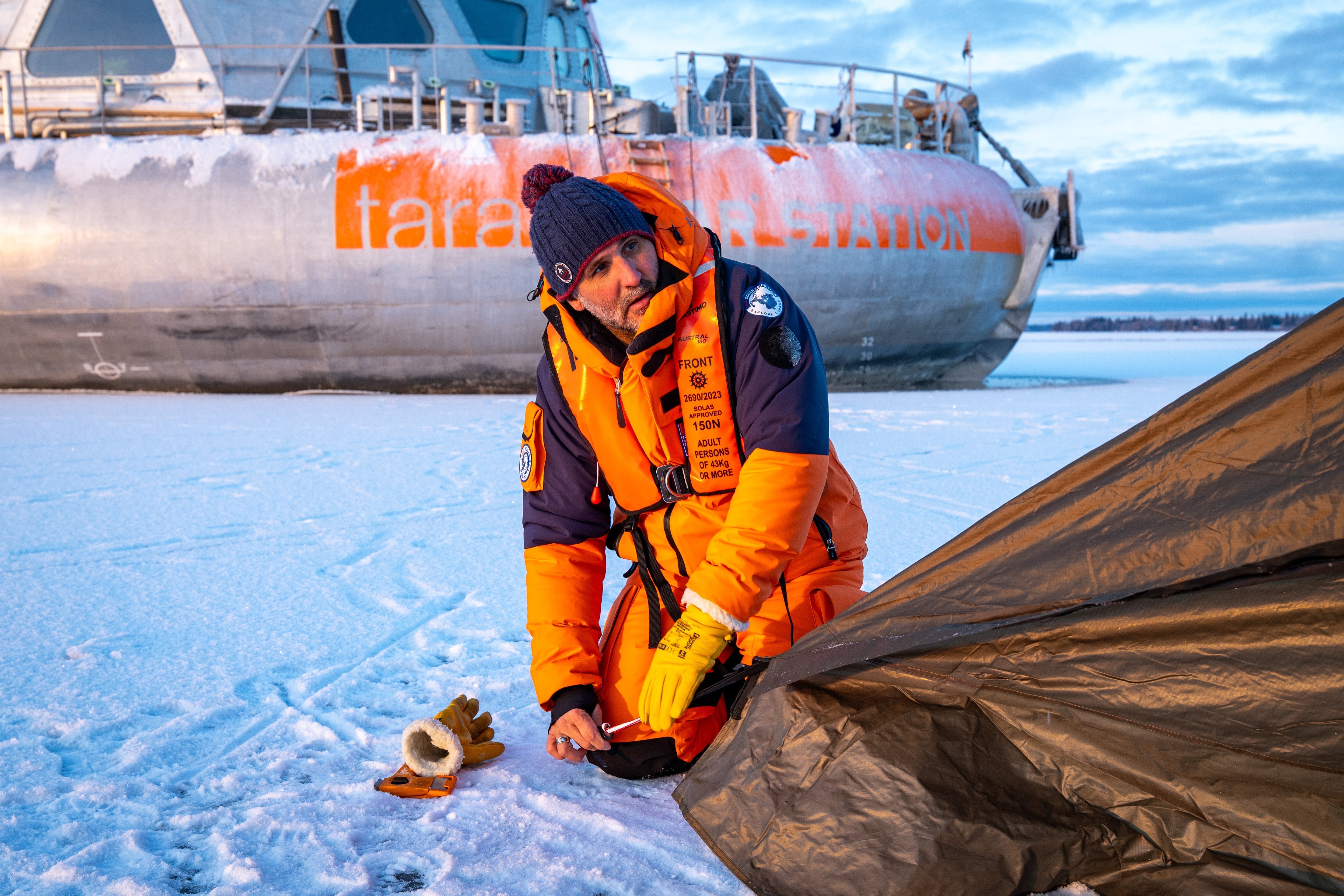
You’re a finalist for the Shackleton Medal for the Protection of the Polar Regions because of your leadership of the project to construct the Tara Polar Station, a floating laboratory that sounds like something out of Jules Verne. It’s a circular aluminium vessel, 16 metres wide and 26 metres long, with a 30-ton geodesic dome at the centre. How did you come up with the concept?
I've been thinking about this project for the last 10 years. It was a huge challenge to raise the funding, a huge challenge to design it and to build it. (It’s designed around a central moon pool that allows researchers to collect ocean samples 2,500 meters below the surface. It is built to withstand temperatures as low as -52 degrees Celsius. It contains five laboratories, including both wet and dry facilities, as well as areas for in situ experiments, ice core sample handling, and sample storage. In addition to laboratories and instruments, the vessel features offices, a wheelhouse, cabins, a mess hall, a galley, a sick bay, laundry facilities, and other standard components. The desalination unit can produce 300 litres of water per hour. The vessel is also powered by wind turbines, solar panels, and bio-based fuels.) My challenge now is to put together a team of 40/50 laboratories around the world to make sure the best science results from it and also to recruit the right people to take part. Over the next 20 years, there will be 10 consecutive missions with the station.

Where did the funding eventually come from?
Prince Albert II of Monaco, through the Prince Albert II of Monaco Foundation and Monaco Explorations, was the first to support the Tara Polar Station. The French State then covered 60% of the investment as part of its strategy. Other support came from BNP Paribas, the Albedo Foundation for the Cryosphere, agnès b, the Didier and Martine Primat Foundation, Capgemini Engineering, the Veolia Foundation and Bureau Veritas.
The Central Arctic Ocean is one of the most difficult areas to analyse on the planet. This is going to allow crucial continuous observation and the gathering of 25 years of consecutive data to understand the future trajectory of the Arctic.
We're going to be investigating a lot of issues. And we will be needing to devise solutions all the time in response to what’s happening. It will be an interesting time for the 12 people who are going to be there for the first winter. Some of the challenge is, of course, technological, but there are also issues of engineering, how people on board will be able to repair stuff. Though the biggest challenge of all is human – to make sure that we have a group of people who behave together, who are efficient, and who would be happy to be together for the next nine months. [The first crew of 12 (with 6 scientists) will be onboard from August through to the following spring, followed by a crew rotation which will increase up to 18 people for the summer. The Tara Polar Station is designed to be self-sufficient for up to 500 days, carrying 10 to 12 tons of food, as well as supplies, including equipment to grow small amounts of fresh produce such as lettuce, herbs, and tomatoes. To keep the team in good spirits, the vessel is also equipped with a sauna.]
What is your central aim?
The clock is ticking. As we know, the Arctic is warming at least four times faster than the rest of the world. We are the last generation to be able to conduct this level of research before it’s in danger of changing completely. We will be looking at what’s happening in the sea ice and the atmosphere. All the food chains in the Arctic start in the sea ice. You lose the sea ice, you lose this ecosystem that has evolved around the ice. One of the concerns is that we are losing species before we have time to discover them.

What technology are you deploying?
To measure what’s happening we have a lot of devices – lasers, instruments for measuring the structure of the atmosphere, a drone and autonomous vehicles that we can navigate below the ice to send down to the bottom of the ocean. There will also be specialised microscopes on board for working on genomics.
What sparked your interest in the poles?
I was raised in the mountains, so I spent my early life familiar with extreme cold. Then, when I completed my education [he has a double degree in biotechnology and business management] I joined a company doing research into polar logistics and mammoths – that was my earliest training. It was back in 1999. I worked in Siberia in a tiny peninsula to the north of Khatanga, in the Krasnoyarsk region of Russia. I was part of a team [led by the French explorer Bernard Buigues] that was digging up a mammoth. It was – 50 °C, and we had to be very careful about everything we did. I’ve always believed in making careful preparations and not doing anything crazy. The Discovery Channel made a documentary about it [Raising the Mammoth – it would prove to be one of the network’s top-rated programmes]. I’ve had bigger challenges since, but it was a huge adventure.
In 2006 you were on the mission to analyse disappearing sea ice with the Tara Schooner, which was the last transpolar drift to take place.
After I joined the Tara Foundation, we took the Tara Schooner on an 18-month expedition where it was trapped in the ice pack. I'm not, if you ask me, an explorer per se; I’m not an ego tripper. I’m not doing this for myself; I’m driven by getting to know the polar regions better so that we can protect them.
This is a mission that everyone's going to want to know about. What does your outreach programme look like?
There is already a documentary that will be out in June for the first year of testing. We want it to be broadcast in many languages. There are, of course, plans to host journalists on board. We have already had a very strong press impact in many countries. We got the King of Denmark on board, the Prime Minister of Iceland on board, and the Prime Minister of Finland. For the first time, in the last two years, we now have this broadband access to the Arctic, beyond 80 North, and we have low-orbit satellites. So we can do live podcasts, we can do live connections with news. We're going to have many nationalities on board – some Canadians, some Germans, some Swiss, some French, and later on, some Finnish. So we will build on the presence of these people to create interest in their different countries.
Who were the figures who inspired you when you were developing your interest in the polls?
Liv Arnesen, I loved Liv Arnesen. I was impressed by Borge Ousland – Borge is a superstar. I was impressed by the books – I read Nansen, Amundsen, [Adrien de] Gerlache. I was dreaming about this kind of exploration when I was a kid. Jules Verne was also an inspiration – we named our son Nemo.
You trained as a microbiologist. Is there a particular line of inquiry that you're impatient to pursue?
This kind of environment is full of resources and full of surprises. On the Tara Polar Station, we have a lot of technologies to look at the biomass and biodiversity of fish that we have there. There’s a 16-year moratorium in the Arctic today to prevent unregulated fishing so scientists have time to understand the ecosystem. Beyond that, if you look at science over the last 50 years, many discoveries have been made in this kind of extreme environment, because this is where life innovates a lot. What drives me is that the Arctic will change completely. We must understand it, because the sea ice is our common heritage.