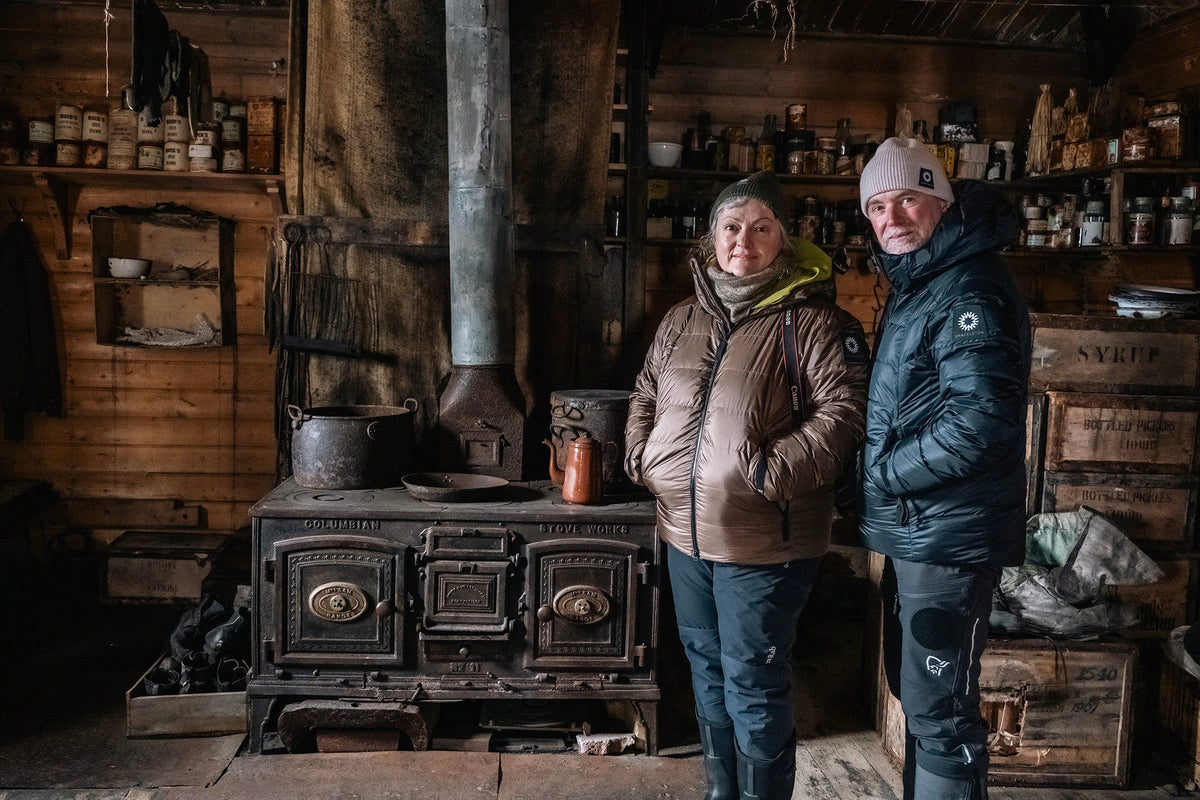
Inside Midnight Sun: A shared passion for cold places
On October 6, polar photographers Sue Flood and Ian Dawson will be interviewed by Michael Palin at the Royal Geographical Society about their new photography book, Midnight Sun. Here, the two of them (both judges for the Shackleton Medal for the Protection of the Polar Regions) talk about escaping avalanches, pursuing polar bears, and their passion for the cold.
When Sue Flood woke up one morning to realise that the sea ice around her tent had broken up – leaving her and fellow photographer Doug Allan perched precariously on a floe only 100ft wide – she thought they were going to die. They were filming for the BBC's Blue Planet in the High Arctic, and as they surveyed their surroundings, 'there was no obvious way we could get off it,' she declared. Both had extensive experience of working in extreme environments; both were pioneers in wildlife photography. As – fearing the worst – they sent off an emergency signal to a satellite, Allan turned to Flood and said, 'If we get rescued, will you marry me?'
Polar photographer Ian Dawson also remembers a near-death experience, in his case in Alaska. 'The entire side of a mountain avalanched,' he says. 'I'm not talking a small gully – this was a few kilometres. As this immense wall of snow came towards us, my friend Martin and I actually shook hands, as if to say "We've come to the end, but at least we've died doing something we love".'
As the conversation I had last week with both of them indicates, both survived. Flood went on to marry Allan and continued to tour the world as a wildlife photographer, while Dawson, a respected photojournalist and former picture editor who has worked for publications including The Sunday Times and Vogue, defied the threat of avalanches to further establish his polar credentials. Flood's marriage to Allan would eventually be dissolved – though they remained good friends till he sadly died in Nepal earlier this year. But she never lost her fire for adventure as she pushed herself to her limits to capture spectacular images of wildlife in remote locations.

Seeking the Midnight Sun
Now Flood and Dawson have combined their extensive experience to produce Midnight Sun, an extraordinarily moving book of polar photography with a foreword from Ernest Shackleton's cousin, Jonathan. The book ranges between scenes of magnificence and bleakness, optimism and fear, humour and foreboding. As they talk to me over Zoom about their new collaboration, it's clear that both have been profoundly shaped by the passion that they both have for the Arctic and Antarctic. 'When conditions are challenging – that's when I feel most alive,' says Dawson. 'We were at Scott's Hut in Cape Evans in February, and it was minus 40 in a blizzard. We could hardly see the hut. It was exhilarating.'
Flood, who, like so many of us, was weaned on David Attenborough documentaries, also remembers watching a National Geographic documentary, Arctic Kingdom: Life at the Edge, which featured footage from Allan. 'I'd never seen a bowhead whale or a narwhal before,' she says. 'I was fascinated to see something so different. When I managed to get a job on Blue Planet, the producer Alastair Fothergill was really good at putting us on projects we wanted to do. For me that led to three years of working in the Arctic and Antarctica. I just fell in love with both of those places, and that passion has never gone away.'
A landscape in constant flux
To look through their book is to be woken up once more to the many moods of the polar environment. Dawson's black and white image of Thwaites Glacier is darkly apocalyptic, while Flood's coloured photograph of a polar bear streaking the snow with blood as it drags a dead seal in its mouth bears testament to the Arctic's savage beauty. A picture of an orca, taken by Dawson in McMurdo Sound, has a magnificent clarity in which you can see every bubble of water displaced by the beast. Meanwhile, Flood's image of two emperor penguins touching beaks as their chick nestles between them may first strike the viewer for its pleasing symmetry, but what should be more striking is the patience and expertise needed to capture this pose. Flood, who earlier published a book, Emperor: The Perfect Penguin, declares that 'All the time I've spent in emperor colonies, it's the only time I've seen them exactly like that.'

Mission for the future
The book is a project from their company, Midnight Sun Voyages, which they founded in 2023. As their website puts it, it has been set up for 'invitation-only photographic journeys to the planet's most remote regions'. Both Flood and Dawson are driven by the belief that photography of remote environments is a powerful tool when it comes to making people care about climate change. Their book quotes David Attenborough – with whom Flood has worked extensively – saying, 'No one will protect what they don't care about; and no one will care about what they haven't experienced'.
Attenborough was a deeply formative influence for both. Dawson clearly remembers the famous programme from the Life on Earth series in which Attenborough met gorillas in Rwanda: 'It's one of those things that's become part of my cultural makeup'. Flood remembers 'watching him at home on TV in North Wales. I decided then and there that I wanted to work with him. To get to actually do that for 11 years was a dream come true.'

The decisive moment
A big turning point in Flood's career was to realise how the impact of a still image could be just as – or even more powerful – than a moving one. 'If you take a picture of a tabular iceberg in a storm, you can talk about the amount of water tied up in there, or if a polar bear is jumping from floe to floe, you can talk about sea ice breaking up.' During her time on Blue Planet, she was also managing to capture wildlife behaviour that hadn't been observed before, including 'polar bears hunting beluga whales in Lancaster Sound'. This became another close call when the polar bear briefly decided it was more interested in her and a fellow cameraman than it was in the whales, and they had to scare it off with pepper spray. Little surprise that at the start of this year her achievements were rewarded with an OBE for services to photography.

Strength in numbers
It's clear that she feels she's met the ideal photography partner in Dawson, who, among his many achievements, has been awarded Diamond and Platinum Jubilee medals by Queen Elizabeth II for his work in Scottish Mountain Rescue. 'Ian is very good in pressurised situations,' she says. 'He's also a paramedic, and I've seen numerous occasions on which everyone else is panicking and he's remained calm.' When they first met on a voyage to the North Pole, they bonded after 'we started talking about the cold. He'd heard me talking about the Nenets and said: "I'd love to go there". I realised we had this shared passion for cold places, and the more time we spent together, the more this great friendship developed.'
Do they compete with each other? 'We're competing against ourselves,' says Dawson. 'We're very supportive of each other's work, but we're our own worst critics.' Flood asserts, 'Even if we photograph the same thing, we do it in a very different way. That's why it's been extremely rewarding working on this book. My husband Chris says I'm actually much happier when I'm working with Ian than I am when I'm working on my own. I think he's very pleased about that.'
Building a legacy
The pair have several future projects in the pipeline – some of which are currently top secret – but which include camping with emperor penguins later this year. The exhibition connected to their Midnight Sun book, which opens at the RGS on October 6, will also be touring internationally. Both are strongly aware that the importance of their images is tied in no small part to the fact that the environments they document are changing so rapidly, with the impact on the species they portray becoming ever more unpredictable. 'These are not just pretty pictures,' says Flood. 'Just to give one example, since I took that photograph of the emperor penguins and their chick, emperor penguins have been classified as endangered by the International Union for the Conservation of Nature'.
It's clear, after only a brief time with them, that both live for what they do. 'The thing I love about photography,' says Dawson, 'is that I've never reached the point where I become bored or too familiar with it. It's always exciting. I'm always trying to get beyond what I've done before. I ask myself what I can do that's new. What can I try? I'm striving to see what I can do differently, hopefully so that it's better, just pushing what I do.'

The book launch, together with an interview at the RGS with Michael Palin, will be on October 6 from 7pm till 9pm. Link here for tickets
Midnight Sun is published by ACC Books. Price: £75, available to buy online via the UK Antarctic Heritage Trust website.
By Rachel Halliburton